Buses
Мощност
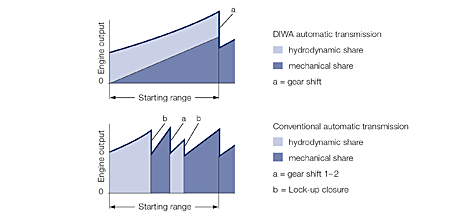
The DIWA driving mode replaces the first two gears of a conventional automatic transmission.
rcuit)
The benefits to you:
Less shifting
Less wear
High cost-effectiveness
More comfort for passengers and drivers
(Reduced thermal load of the engine cooling ci

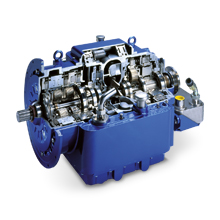
The design of the DIWA.3E transmission is simple, logical and clear. The main piece is the
hydrodynamic offset converter. The pump brake, coupling, differential transmission and input coupling as well as the coupling for the overdrive are located to the front of it.

All Voith DIWA transmissions work according to the power distribution principle. It
provides even start-up and acceleration through a speed range in which other drives would have to shift 2 to 3 times.
| Types | D 823.3E | D 851.3E | D 854.3E | D 863.3E | D 864.3E | |
| Input power P1max | [kW] | 180 | 220 | 220 | 290 | 290 |
| Input torque M1max | [Nm] | 650 | 1.100 | 1.100 | 1.600** | 1.600** |
| Input speed n1max | [min -1] | 2.800 | 2.800 | 2.500 | 2.800 | 2.500 |
| Retarder brake torque MBR*** | [Nm] | 2.000 | 2.000 | 2.000 | 2.000 | 2.000 |
| Number of gears**** | 3 | 3 | 4 | 3 | 4 | |
| Dimensions transmission (dry) incl. retarder inkl. Retarder |
[kg] | 270 | 275 | 310 | 280 | 315 |
| Max. vehicle weight | [t] | 15 | 28 | 28 | 28 | 28 |
| Main areas of application | Midi- busses | Standard line-, single and articulated busses |
Line busses with high transmission input torque also for interstate/intercity use |
|||
** For engines larger than 1,300 Nm with torque reduction when shifting,
possible up to 1,700 Nm under certain conditions
*** Maximum value, depending on retarder configuration
**** 1st gear with hydrodynamic/mechanical power division (DIWA driving mode)

The topography-dependent shifting program SensoTop optimally matches all shifting points to acceleration, distance profile and loading.
A tilt sensor delivers to the transmission control the necessary information for the stepless adjustment of shifting points. The driver has the best engine power available for level roads or mountainous terrain and heavy or light loads.
Practice shows that depending on topography and vehicle use, you can save up to 7% in fuel. A significant contribution to economical and environmentally-friendly vehicle operation.
SensoTop